Americans United has been carefully watching President Donald Trump’s Religious Liberty Commission since its inception. AU President and CEO Rachel Laser and I even attended its first meeting at the Museum of the Bible in Washington, D.C.
Although the commission was purportedly tasked with advancing religious freedom for all Americans, it was clear from that first day that the commission was biased and that its focus would be far more narrow. Like most things from this administration, it was created with an end goal in mind. Now that the commission published its draft report on June 26, it’s clear that the report is a vehicle for advancing Christian Nationalist talking points to attack the separation of church and state.
This version of the report is billed as a draft, and the commission is accepting public comments through July 13, 2026. We urge you to use our quick and easy portal to submit your own comments and explain to the commission the vital role church-state separation plays in protecting religious freedom for all. You may recall that Americans United and Democracy Forward filed a lawsuit to prevent the publication of the final report; the lawsuit is currently pending.
We found it curious that the draft report was released at 4 p.m. on a Friday. That’s usually when you dump news you want to bury. Indeed, maybe it was released on a Friday afternoon because it’s not exactly news. The report says a lot of what you’d expect. It paints American “Christians” (I use quotation marks because I don’t want to paint with as broad a brush as the report does) as endlessly persecuted. Indeed, the report uses a version of the word “hero” no less than 22 times to describe the people it insists are victims of the government’s “anti-Christian bias.”
Unsurprisingly, included in its lengthy list of recommendations is that the federal government should establish “a Presidential Medal of Religious Liberty and First Freedom Hero Awards to recognize Americans who stand up for religious freedom.” We know the president loves gilding everything from statues to the Oval Office, so why not give party favors to the people who are so unhappy that they can’t force prayer on their public school students or cite their religious beliefs to deny medical care to their patients?
Our policy experts are carefully reviewing the 200-plus-page report and preparing Americans United’s official comments in response, but it’s important to highlight a few things:
First, the report doesn’t have a lot of substance. If you watched the commission’s hearings, you’ll know what’s in it. Most sections are regurgitations of the testimony they solicited (primarily from Christian Nationalist organizations and their clients) followed by a conclusion with recommendations with no analysis of that testimony or context for it. The word that keeps coming up with my team while reviewing this report is “shoddy.”
In a funny-if-it-weren’t-so-problematic twist, the report actually cites to Americans United’s public comments in advance of the meeting on religious liberty in the military, but it does so inaccurately. It makes one wonder what else is inaccurate in the report.
Second, the recommendations are in large part about issuing “guidance” and creating Know-Your-Rights documents, such as posters. The commission seems highly concerned that people don’t know their rights.
As a former federal career official at two different agencies, I can testify that it would take the federal government years to create all the deliverables the commission is recommending. And, given this administration’s penchant for stretching the law well beyond its extremes to mean something it doesn’t, I can’t imagine those guidance documents will be accurate.
Third, I started by mentioning the predetermined goals of this report; those goals are evident in the topics the report hits again and again. Like other things we’ve seen from this administration, such as the “gender ideology” Executive Order and the Anti-Christian Bias Task Force report, this report despises any treatment of transgender people, especially children, with dignity and care.
An entire chapter is dedicated to ending the Johnson Amendment, which prohibits nonprofits, including houses of worship, from electioneering and endorsing candidates. (AU successfully helped to defeat legal efforts to gut the Johnson Amendment earlier this year.) And the cause that brought Americans United into existence also got a lot of ink, with many calls to establish and expand private school voucher programs to siphon taxpayer funds to private religious schools.
But most of all, the report explicitly attacked the separation of church and state. They call it a “myth” that, according to them, the Supreme Court essentially created with its jurisprudence starting in the 1900s. They say it “erases” religious individuals and perspectives from public life in America. They really push a new narrative that, rather than a wall, there should be “a bridge between church and state.”
Their very first recommendation is, “Instruct the Department of Justice to issue guidance clarifying the proper understanding of the Establishment Clause and separation of church and state.” I imagine that “clarification” will be simply that the separation of church and state doesn’t exist.
But setting aside for a moment the unrelenting antipathy to church-state separation, the commission’s narrative is disingenuous because of the way it seems to act like church-state separation just sprang up to harm America in the last few decades. It’s not unlike the tweets I’ve seen from some people after the Supreme Court upheld the constitutionality of birthright citizenship, as if the ruling actually changed something. But the Fourteenth Amendment’s guarantee of birthright citizenship isn’t exactly new. And neither is church-state separation.
Here at Americans United, we often refer to church-state separation as an American original. It is – and it’s been around for as long as the modern idea of the United States has existed. Not only is church-state separation not new, religious individuals and perspectives are demonstrably not erased from the past 250 years of the American experiment because of it.
Americans of all religions and none are protected – and our democracy is strengthened – by church-state separation. So the commission – and this administration and its Christian Nationalist allies – can say whatever they’d like. That’s defended by the First Amendment. But so is the separation of church and state – and it won’t go anywhere on our watch.
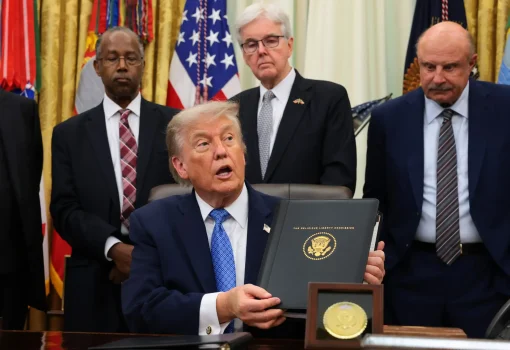
Photo: President Donald Trump displays the Religious Liberty Commission’s draft report during an event in the Oval Office of the White House on June 26, 2026, in Washington, D.C. Photo Credit: Anna Moneymaker/Getty Images