The Religious Liberty Commission held its last hearing this Monday before the release of its draft report and recommendations. This capstone meeting touched on many of the fictions that the commission has repeatedly advanced over the year.
Like in the previous six meetings, the commission meeting excluded the voices of anyone who seeks to protect church-state separation. It also omitted the perspectives of those whose own religious freedoms and civil rights are harmed when religion is forced on them in school, the workplace, or when trying to get health care or social services. And commission members promoted an “us versus them” narrative that casts those raising these concerns as the enemy of religion and of the country.
At AU, we fight for religious freedom for everyone. I want to offer some responses to the fabrications we heard from the Religious Liberty Commission on Monday:
The separation of church and state is a bedrock American principle that is the foundation for religious freedom and is grounded in the U.S. Constitution, the country’s highest source of law. The Constitution only refers to religion twice: in the First Amendment, which bars laws “respecting an establishment of religion or prohibiting the free exercise thereof,” and in Article VI, which prohibits religious tests for public office.
The Constitution does not mention Christianity, God, or Jesus. This omission is meaningful. At the time the U.S. Constitution was written, religious governments were the norm. Until America’s founders crafted the First Amendment, no nation had put an official distance between religion and government. The choice to create this separation did not happen in a vacuum. Many of the founders were students of history or were themselves descended from people who remembered the hundreds of years of violence, terror, and war fought over the religious identities of European nations.
Church-state separation protects all peoples’ religious freedom. Separation protects houses of worship from intrusion by the government, guaranteeing their independence and allowing them to remain free of political control and interference. It also protects the right of individuals to believe or not, without interference from the government, as long as their actions don’t harm others. The principle is cherished by a multitude of religious denominations and organizations, as well as people of faith and people who are nonreligious.
Concerns about government interference are not just theoretical. In the last week, for example, the Trump administration has repeatedly threatened and attacked the Catholic Church in attempts to coerce support for its war in Iran. President Trump also posted an image of himself as Jesus — something deeply offensive to millions of Christians in this country and around the world.
Separation has also allowed the U.S. to be one of the most religious and religiously diverse countries in the world. People who support church-state separation belong to a variety of faith traditions, including Christianity, alongside those who are unaffiliated and nonreligious. Thousands of religions flourish in our country because of our commitment to religious freedom.
Commissioners repeatedly tried to characterize those advocating for church-state separation as extreme and claim they are bankrolled by well-funded interest groups. This characterization minimizes the majority of Americans who support this foundational principle.
It also conveniently ignores the well-funded, Shadow Network of extremist groups, including the Becket Fund, First Liberty Institute, and Alliance Defending Freedom, systematically seeking to dismantle these key protections and undermine democracy. Leaders of these organizations shaped the agenda of, provided witnesses for, and even sat on the Religious Liberty Commission. Alliance Defending Freedom’s annual revenue is well over $100 million — and that’s just one organization.
Perhaps in response to our lawsuit challenging the Religious Liberty Commission’s one-sided narrative, Commission Chair (and Texas Lieutenant Governor) Dan Patrick repeatedly asserted his respect for and inclusion of Americans of all faiths. Yet, the rhetoric and underlying policies supported by the commission tell a different story.
For example, this commission meeting featured anti-Muslim sentiment. Eric Metaxas, an author and radio host serving on the commission, repeatedly tried to bait a witness into accusing Muslims of driving anti-Hindu attacks. Patrick also delighted in saying that schools in Texas post the Ten Commandments, set aside time for prayer, and will soon require students to study the Bible — all of which force one particular version of Christianity on students while ostracizing students from different or no religious backgrounds, belying his claims about inclusion.
Fundamentally, the commission promotes a vision of a nation that serves conservative Christians’ religious beliefs, even when this harms others. The commission has systematically ignored and excluded the people on the other side of the “liberties” — women seeking reproductive health care and rights to bodily autonomy, trans people seeking to live their lives freely, Jewish parents seeking to foster children through a local taxpayer-funded agency, a Buddhist kid facing disparagement and proselytization in his public school, or a Sikh servicemember seeking to wear his articles of faith. We have highlighted these examples, alongside countless others, in our comments to the commission.
Religious freedom means freedom for all, not just the powerful. Dismantling church-state separation threatens to undermine protections for Americans of all faiths and none, harming these core principles the Religious Liberty Commission claims to stand for. The commission’s upcoming report and recommendations will undoubtedly perpetuate the lies they’ve told throughout the year.
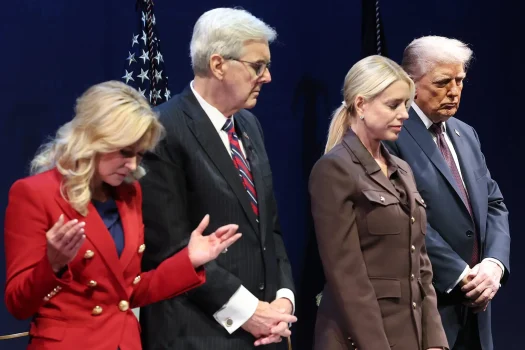
Photo: President Donald Trump bows his head in prayer during a September 2025 meeting of the Religious Liberty Commission at the Museum of the Bible in Washington, D.C. Joining him are, from left, Pastor Paula White-Cain; Commission Chairman and Texas Lt. Gov. Dan Patrick; and former Attorney General Pam Bondi. Credit: Win McNamee/Getty Images