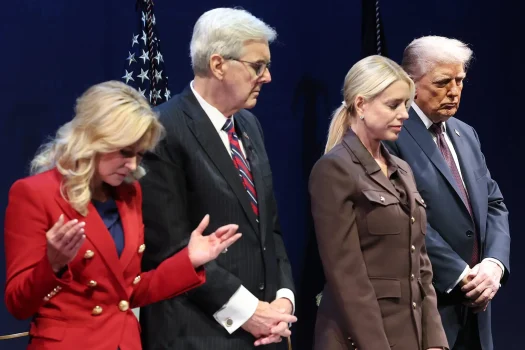
After three sessions held in Washington, D.C., President Donald Trump’s Religious Liberty Commission is hitting the road. Its next meeting, focused on “Religious Liberty in the Military,” is scheduled for tomorrow at Old Parkland in Dallas, Texas. We’ll have coverage of that meeting later this week.
Today, we want to talk about the venues hosting the commission meetings – institutions established by and pursuing the causes of wealthy donors devoted to fighting against church-state separation. These locations tell us a lot about the agenda of the commission.
The Religious Liberty Commission – a federal advisory committee – held its first three meetings not in any of the dozens of federal buildings in D.C., but at the Museum of the Bible, a privately owned museum that exists to promote the same one-sided, inaccurate world view that the commission peddles.
The Museum of the Bible was founded by Steve Green, the president of the craft store chain Hobby Lobby. His company gained legal notoriety in Burwell v. Hobby Lobby Stores, a 2014 U.S. Supreme Court case where Hobby Lobby successfully argued it should receive a religious exemption as a privately held, for-profit corporation to strike down the Affordable Care Act’s requirement that employees’ health insurance plans cover contraceptives. The decision allowed Hobby Lobby’s owners to impose their religious beliefs on their employees by denying them health care benefits.
In addition to Green, the museum is supported by the DeVos Family Foundation – a name you’ll recognize belonging to former Secretary of Education Betsy DeVos during the first Trump administration – and a number of other conservative donors. The museum’s 15 years of operation have been filled with controversy, including allegations of racial profiling and displaying fake and potentially illegal artifacts (in 2017, Hobby Lobby itself was involved in scandal after purchasing smuggled antiquities).
Given these funders, it’s unsurprising that the museum has a clear political project – to promote the lie that a particular form of conservative and exclusionary Christianity is foundational to American history and culture. In his initial filings with the IRS, Green described the purpose of the museum as “to bring to life the living word of God, to tell its compelling story of preservation, and to inspire confidence in the absolute authority and reliability of the Bible.” Organizers of events held at the museum called it “an ‘Ark of the Covenant’ for our nation” and “God’s base camp.” And Candida Moss, a British journalist and co-author of a book on Green’s Christian Nationalist agenda, has said, “It’s not really a museum of the Bible, it’s a museum of American Protestantism. Their whole purpose is to show this country as a Christian country governed by Christian morality.”
The Religious Liberty Commission’s fourth meeting is set to be held tomorrow at Old Parkland in Dallas, “an exclusive investor enclave” owned by Harlan Crow.
Crow is perhaps best known for his close relationship with (and extensive undisclosed gifts to) U.S. Supreme Court Justice Clarence Thomas. Crow is also a champion of conservative causes. He’s given over $10 million in publicly disclosed political contributions, and much more in dark money that is not fully known. Old Parkland is a power center for Dallas’ wealthy and elite. It has leased offices to former President George W. Bush and former Texas state Rep. Dan Branch and hosted a conference series sponsored by conservative think tanks.
Presidential committees often meet in federal government offices where available. A Department of Justice-housed advisory committee like the Religious Liberty Commission may meet in DOJ’s D.C. headquarters, for example, which has hosted similarly sized events in its storied Great Hall. The commission hasn’t shared any information about why it opted for or how it selected these sites.
All of this raises ethical concerns. We don’t know whether the commission used taxpayer funds to rent meeting spaces at either the Museum of the Bible or Old Parkland, or whether it was given free access (AU filed records requests in October to learn more about the commission’s arrangements with the Museum of the Bible; we’re awaiting a substantive response from the Trump administration). Holding meetings on private property likely requires the commission to pay for additional costs that it would not have incurred had it used a federal office building, such as for security and technical support. Beyond any direct rental fees, the venues stand to receive indirect financial benefits (for instance, instructions to attend the third commission meeting included descriptions of the museum’s restaurant options).
A quick exploration into the commission’s meeting hosts underscores what we already knew: The commission is not a genuine and impartial inquiry into the state of religious freedom in this country. Instead, it’s another example of the Trump administration misusing taxpayer funds to reward donors and to promote a Christian Nationalist vision of this country.